Every technology we've adopted has changed us a little: how we behave, how we think, who we are. AI is doing the same, only faster. Things that sounded impossible a few years ago are routine now. In a lot of areas we're being outpaced, and sometimes replaced, sooner than most of us expected. So I keep asking myself a simple question: what makes us human, and how do we stay human when AI is everywhere?
I started thinking about this after reading an essay by Stephanie Shen that rethinks the brain, emotion, art and intelligence in the age of AI. She questions the habit of describing the mind as a computer, with input, processing and output, and points to what that model leaves out. We live in the world. We feel as much as we reason. We look for meaning through other people.
Three things that make us human
When I try to answer the question for myself, I land on three things.
1. Emotional intelligence. This is our ability to perceive, understand and manage our own emotions, and to recognise and influence the emotions of others. We don't just listen to people, we read them: a gesture, a smile, a change in someone's face, the silence before an answer. We pick up what it means almost without thinking, and we bring our whole history with that person into how we read it.
2. How we decide. Deciding means choosing one course of action out of several. We look at a situation as a whole: the facts, the feelings, what happened last time and what's at stake. Then we make a call, often with incomplete information.
3. We build norms together. Every community, whether it's a family, a company or a country, agrees on a set of rules, and those rules create a context where things make sense. But the context doesn't stay still. When it changes, the norms have to change with it, and somebody has to notice that moment. So far, that somebody has been us.
Underneath all three is sensitivity. We notice small differences and we have feelings about them. Something as simple as the colour of a background can completely change how we feel about a page. That sensitivity is human.
Agents, and who should make decisions
Boris Cherny, the creator of Claude Code at Anthropic, describes five steps of AI adoption inside organisations. I think it's a useful map of where the human sits at each stage:
- Step 0: Gated (0 agents). Capable AI exists, but your people can't reach it. There's no approval path, and legacy security reviews measure the wrong thing: cost per token instead of outcomes. So capable people improvise, with consumer tools on personal accounts and demos that never leave the laptop. What breaks: nothing moves, because nothing is allowed to.
- Step 1: Assisted (~1 agent). One person and one AI work as a pair. The human assigns the work, supplies the context, catches the errors and approves the output. What breaks: your own attention. The pair is only as fast as its human half.
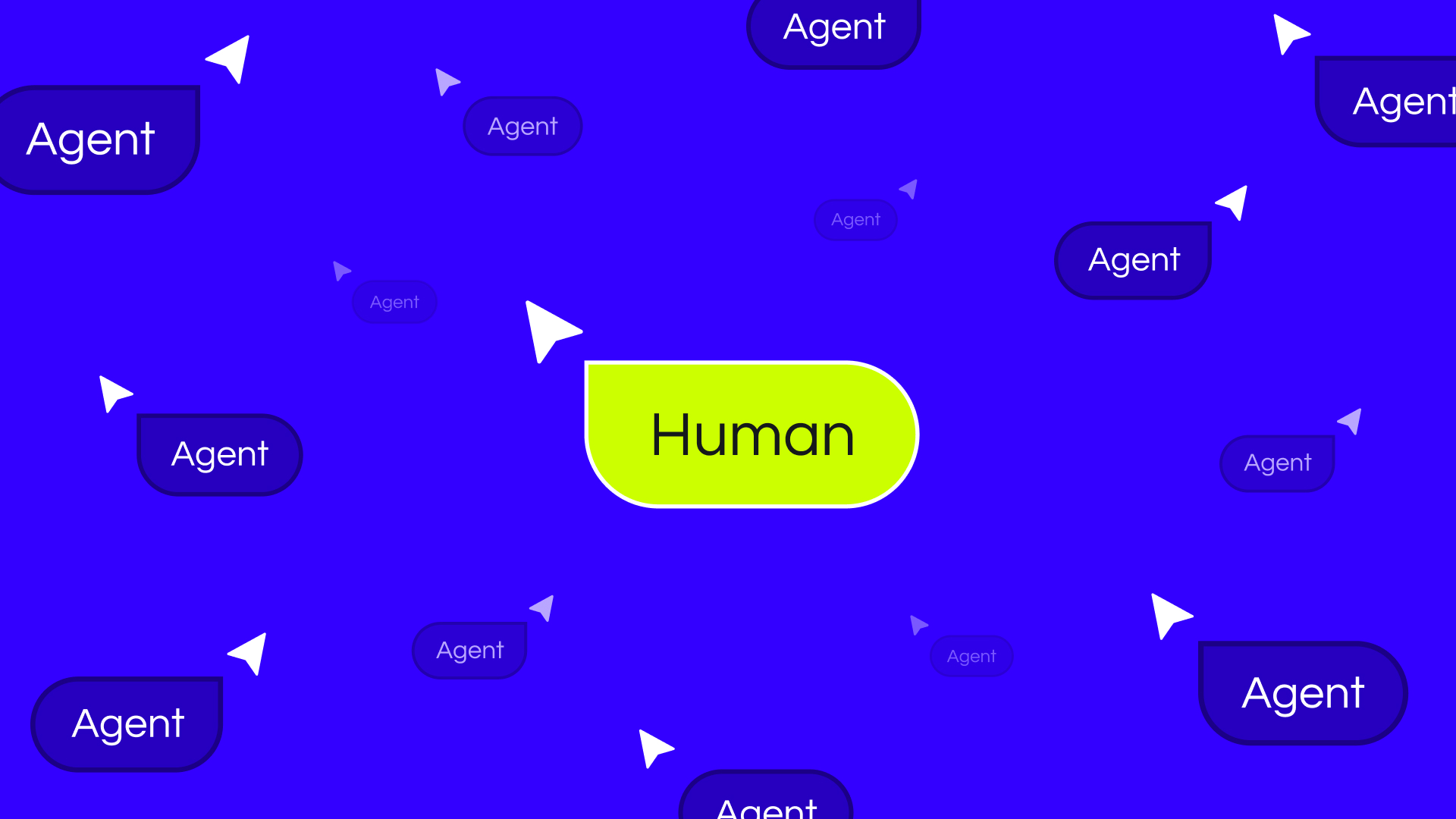
- Step 2: Parallel (~10 agents). The role changes. You stop being a doer with a helper and become an orchestrator, directing five to ten agents on bounded tasks in parallel. What breaks: your review capacity. Ten streams of output, one set of eyes.
- Step 3: Supervised autonomy (~100 agents). Agents delegate to other agents, and schedules and events kick off recurring work. Humans become managers of managers, supervising outcomes, costs and exceptions instead of tasks. What breaks: trust and decision throughput. The system can act faster than you can approve.
- Step 4: AI-native (1,000+ agents). Leaders steer by intent: objectives, constraints, budgets and success measures. Hundreds or thousands of agents do bounded work across the organisation, and people supervise the portfolio. What breaks: the economics of automating at scale, meaning knowing what to expand and what to stop.
We're already living parts of this. One person can now run five projects at once, doing what used to take a whole team. The human imagines, gives direction and decides, and the agents carry it out. That's the second point again: judgement. Somebody has to decide what's worth building, and when it's good enough. I don't expect humans to do everything or check every step. The human supervises, reviews what matters and has the final word.
There's another side to this, and it worries me. Agents are getting more autonomy, and some are starting to build things on their own. As that grows, fewer people supervise the steps, and more of them hand over the final word too. When that happens, ownership and responsibility for the result fade. And the less we exercise the muscles of reviewing and deciding, the more they weaken. We lose touch with what's being built, and we lose control over it.
Why the human side may matter more, not less
As Head of Development, I see this more and more. Today our clients can open an LLM and try to build a platform or a website themselves. It may well come out fine, but they risk ending up with a narrow version of what it could have been, one limited by their own input and judgement. That's especially true when you're building for yourself, because it's hardest to see your own blind spots.
What's harder to get from an LLM is the level of a professional who has studied a field for twenty years. They keep studying, live in that field almost every day, and have more than 10,000 hours of experience in it. On top of that, they bring a methodology: a process and a proven way of getting to results.
In the end, human relationships still carry a lot of weight. Collaboration, brainstorming, aligning on goals and problems, and making the final decisions and approvals are still the most human parts of the process. They slow things down, but that's part of the value.
Price and convenience matter too, so it won't always play out this way. But word of mouth still counts, and I think it will count even more as everything becomes AI-driven. Underneath that is the first point again, emotional intelligence. People want someone who knows them, understands what they mean, and can talk things through and help. They don't want a system that only analyses what they typed.
An opinion from a person who understands your context and what you're trying to build may end up feeling like a luxury. I don't think it should be.
People first
What people need more of now is to talk, collaborate, brainstorm and work together to figure out what they want to build. The building part is getting shorter and easier, and one person can do it alone. The collaboration part isn't like that. It takes human hours, words, smiles, good discussions and, hopefully, agreement on what's worth building, what's good and what's right, from a human perspective.
I don't have all the answers, and I'm not trying to. AI is getting more powerful quickly, and what one person can build alone keeps growing. The question I keep coming back to is how we build great things with others, as teams and as partners. I want to involve more people in that work, not fewer, and put people first.
The context is changing fast, and when it does, the norms have to follow. We'll change too, as we did with every technology before this one. What we can decide is what we keep.